Author Archives: Greg

Templeton Rye

templeton rye

Happy birthday Al Capone! One of the original gangsters, Capone would have been a very old man if he was still alive today. What better way to celebrate than with Al’s favorite booze, Templeton Rye?

Templeton is distilled in Iowa according to the prohibition-era recipe that made it infamous at that time. As a rye whiskey, you get the liquid-cinnamon spice that you’d expect, but there are a couple of surprises in the taste. First, the 40% alcohol gives this whiskey less of a throat burn than other ryes. Second, there are traces of fruit in the flavor, like orange and coconut. These two elements make Templeton an incredibly smooth liquor.

While Templeton makes great Old Fashioneds and Manhattans, I imagine I’ll be drinking this neat most of the time. I’m really trying not to gush here, but this $40 bottle of rye is tremendous, and a fitting toast on Al Capone’s 114th birthday.

Cathead Vodka

cathead vodka

Cathead is a moderately priced vodka from the state of Mississippi. One dollar of every bottle is given to foundations that support live music, and right on the label it says “Support Live Music.”

Cathead is very smooth and tasty with no alcohol burn, and being U.S. made and very well-priced, it’s a great choice for the liquor cabinet. Cathead’s available primarily in the South for about $20 a bottle, though they’ve recently started distributing to Colorado as well. I used Cathead in a Vodka Sour (pictured above), and you can make it at home:

Vodka Sour

  • 2 oz vodka
  • 1 oz lemon juice
  • 1/2 tsp of powdered sugar
  • shake with ice and strain into a glass
  • garnish with a lemon wedge and cherry

I was surprised at how much I liked the Honeysuckle variety of Cathead, too. It’s slightly lower proof than the standard vodka, and there’s a trace of sweetness to it (which is pretty normal with flavored vodkas). I just had the Honeysuckle on the rocks, all by itself, and it’s a really wonderful late-night or dessert drink. The flavor is fresh, clean, and very natural, all of which make it a welcome contender to a way-too-crowded flavored vodka game.

The Perfect Home Bar

dream home bar

So outside of the right liquor, I suppose the perfect home bar would also actually have a bar. I know everyone’s idea of a home bar is different, but join me while I dream about building the perfect home bar…

Desirable qualities:

  • Warmth. Applies to the quality of the hospitality, community, and also the temperature. Must have a fireplace.
  • Lots of wood.
  • Leather seating.
  • Taxidermy. I am not an outdoorsman by any sense of the word, but I imagine large, horned animals will serve two desirable purposes: adding authenticity to the bar and frightening children away from the bar. Ideas include deer, buffalo, and moose.
  • chalkboard paint wall. For specials and patron messages.
  • Good music. Maybe even quiet, pleasant live music.
  • Separate entrance from the house and a separate bathroom.
  • Cigar and pipe smoking occasionally allowed. No cigarettes.

Undesirable qualities:

  • Neon. Beer signs, jukeboxes, etc.
  • Technology. No computers, no TVs, no video games. Rare exception made for sports-based gatherings.
  • Visible modernities. Stuff like stainless steel, blenders, or microwaves. Those can be present, but preferably hidden below the bar.
  • Overuse of cell phones. They’re allowed, but only barely.
  • Bad attitudes and booze snobbery. People are allowed to drink Jägermeister or Loopy with minimal persecution.

Many thanks to DevonTT on Flickr for permission to use a photo of her home bar. It’s almost word-for-word what I’ve described, and I think we can agree it’s pretty incredible, right?

Death’s Door Gin

death's door gin

Death’s Door distills gin, vodka, and white whiskey in Wisconsin – their gin winning a silver medal at the 2012 San Francisco World Spirits Competition. This is one of the “cool new American gins,” and I’ve heard great things about it lately.

In contrast to gins which tout their long list of botanicals, Death’s Door uses only three: juniper, coriander, and fennel, all distilled in a wheat base. The bottles are labeled with the particular juniper harvest that goes into the bottle – mine’s 2010. Death’s Door is a London Dry, so juniper is the king in this gin. It’s very straightforward, serious, and unapologetically tied to its short ingredient list, I’d call it the London Dry-est London Dry I’ve tried.

If you prefer softer, complex gins like Hendrick’s, Aviation, or Bluecoat, you may want to pass. This is not a citrusy gin or floral gin, though the straight-ahead juniper makes it a pretty great cocktail base. Try this drink with Death’s Door:

Gentleman’s Club (pictured above)

  • 1 1/2 oz gin
  • 1 oz brandy
  • 1 oz sweet vermouth
  • 1 oz club soda
  • combine in an old fashioned glass, on the rocks

1792 Ridgemont Reserve Bourbon

1792 ridgemont reserve bourbon

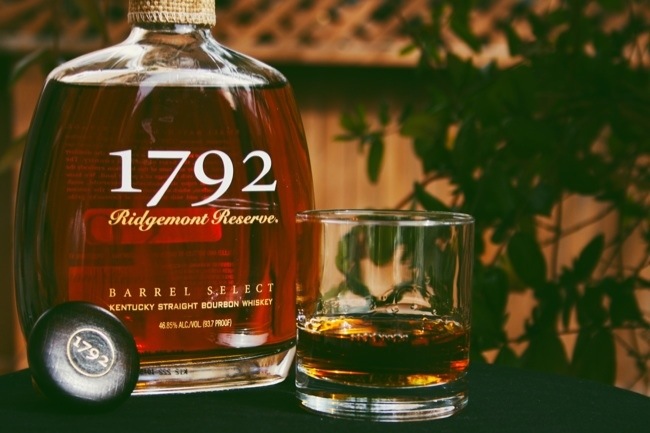
1792 Ridgemont Reserve is a premium bourbon in a wide and stout bottle, the neck wrapped in burlap, and a large carved stopper.

1792 is really meant for sipping but it’s a good cocktail bourbon as well. It’s just over 46% ABV, and I usually take my bourbons on the rocks when I drink them straight. There’s a bit of sweetness present in this bourbon and it brings a great deal of balance to the flavor of 1792. It’s not the sweetest bourdon on the market, nor the spiciest. It’s very smooth, and has the complexity and quality you’d expect from a premium bourbon.

Overall, Ridgemont Reserve is a great middle-of-the road bourbon as it’s flavors are well balanced, and it is certainly as smooth as you’d expect a premium bourbon to be.

Dandy Candy Cocktail

candy dandy cocktail

I adapted this recipe from Bulleit’s Facebook page. It’s low-volume and quite easy to drink.

Dandy Candy Cocktail

  • 1 oz bourbon
  • 1/4 oz sweet vermouth
  • 1/4 oz triple sec
  • 1 dash Bitter End Jamaican Jerk bitters (buy from Cocktail Kingdom), or other bitters of choice
  • stir with ice and strain into a small cocktail glass
  • garnish with an orange twist

Sub Rosa Saffron Vodka

sub rosa saffron vodka

Unfortunately, the sweet (sometimes creepy) flavored vodka category is the #1 seller at the liquor store nowadays. Aside from the philosophy attached to this, let me remind you that vodka is still a legitimate cocktail ingredient, and occasionally, vodka flavors are great additions to the liquor shelf.

Exhibit A: Sub Rosa Saffron Vodka. Distilled and infused at a small Oregon distillery along with a tarragon vodka, it escapes all the trappings of modern “flavored” vodkas, aligning itself more with gourmet cooking than with Katy Perry’s bra.

Sub Rosa has designed a beautiful and simple bottle to showcase the electric-yellow saffron vodka within. Saffron is the world’s most expensive spice at $500-5,000 per pound, and this vodka is rich, aromatic, and savory. Intense flavor like this is usually found in gins, not vodkas. On first taste, I thought about potential cocktail partners for such a unique flavor, and both lemon and olive came to mind. A martini variation is a good start:

Saffron Martini (by Greg Mays)

  • 2 oz Sub Rosa Saffron Vodka
  • 1/4 oz lemon juice
  • 1/2 oz olive juice
  • shake with lots of ice, double-strain into a chilled cocktail glass
  • olive garnish

Crater Lake Gin

crater lake gin
Crater Lake Gin is a straw-colored gin from Bendistillery in Bend, Oregon, who also makes several varieties of vodka. While its label calls it “Handcrafted American Gin,” one of those words can be misleading: American.

I’ve said before that my personal gin preferences lie with London Dry gins, though I love nearly all gins I encounter. American gin, or “western gin,” as it’s sometimes called, usually has another botanical flavor that’s supreme over the juniper that London Drys are known for.

Not so with Crater Lake. For my personal taste, this gin makes the best-tasting martini I’ve ever had. It’s a juniper-lovers gin, with a bit of spice in the finish. It’s silky and smooth, and I’ve nearly drunk half the bottle making strictly martinis. Tasted neat, the spice is more obvious, and the gin is a bit more potent when it’s not ice-cold.

Crater Lake, which was known previously as Cascade Mountain Gin, and can be found throughout the U.S. at retail, or online for about $30. Make it in a martini like this:

Martini

  • 2 1/2 oz gin
  • 1/2 oz dry vermouth
  • olive garnish
  • stir with lots of ice and strain into a chilled cocktail glass

KGB Naranjo, Bourbon, and Absinthe

KGB Naranjo, Bourbon, and Absinthe

KGB Spirits in northern New Mexico has some new releases in their spirits catalog: Naranjo Orange Liqueur, Taos Lightning Bourbon, and Brimstone Absinthe.

Naranjo is a high proof orange liqueur, 45% ABV where most other triple secs are only about 20%. This means it’s not too sweet and Naranjo works well straight up, as a digestif. Naranjo’s orange flavor is very subtle, though, and you should think twice if you’re considering dumping this into a pitcher of margaritas. The color is pale orange, and the scent of citrus is very muted, but it’s all there on your taste buds.

Taos Lightning Bourbon shares it’s name with KGB’s Ryes-a historical throwback to 1800’s western whiskeys-and it’s sweet, spicy, and smooth. I found myself thinking about it all day after tasting it. Taos Lightning Bourbon is very balanced in it’s flavor, and the expected toasted-wood spice finishes it off.

Finally, Brimstone Absinthe has two unique qualities: first, KGB uses a potato base in their distilling process – just like their vodka and gin, which adds a minty, earthy flavor. Second, Brimstone is bottled at a pretty low proof, the lowest proof I’ve ever seen for an absinthe. Absinthe is typically known for it’s high (60-70%) proof, but Brimstone is a mellow 45%. Because of this, you can actually drink Brimstone on the rocks with no water or sugar added. The lower proof makes it a more viable cocktail ingredient, too.

KGB Spirits are available at retail shops around New Mexico.